For landowners
You will do this once. They do it fifty times a year.
Independent, RICS chartered advice on selling development land — whether you have a consent in hand, an allocation in an emerging plan, or a field someone has just written to you about.
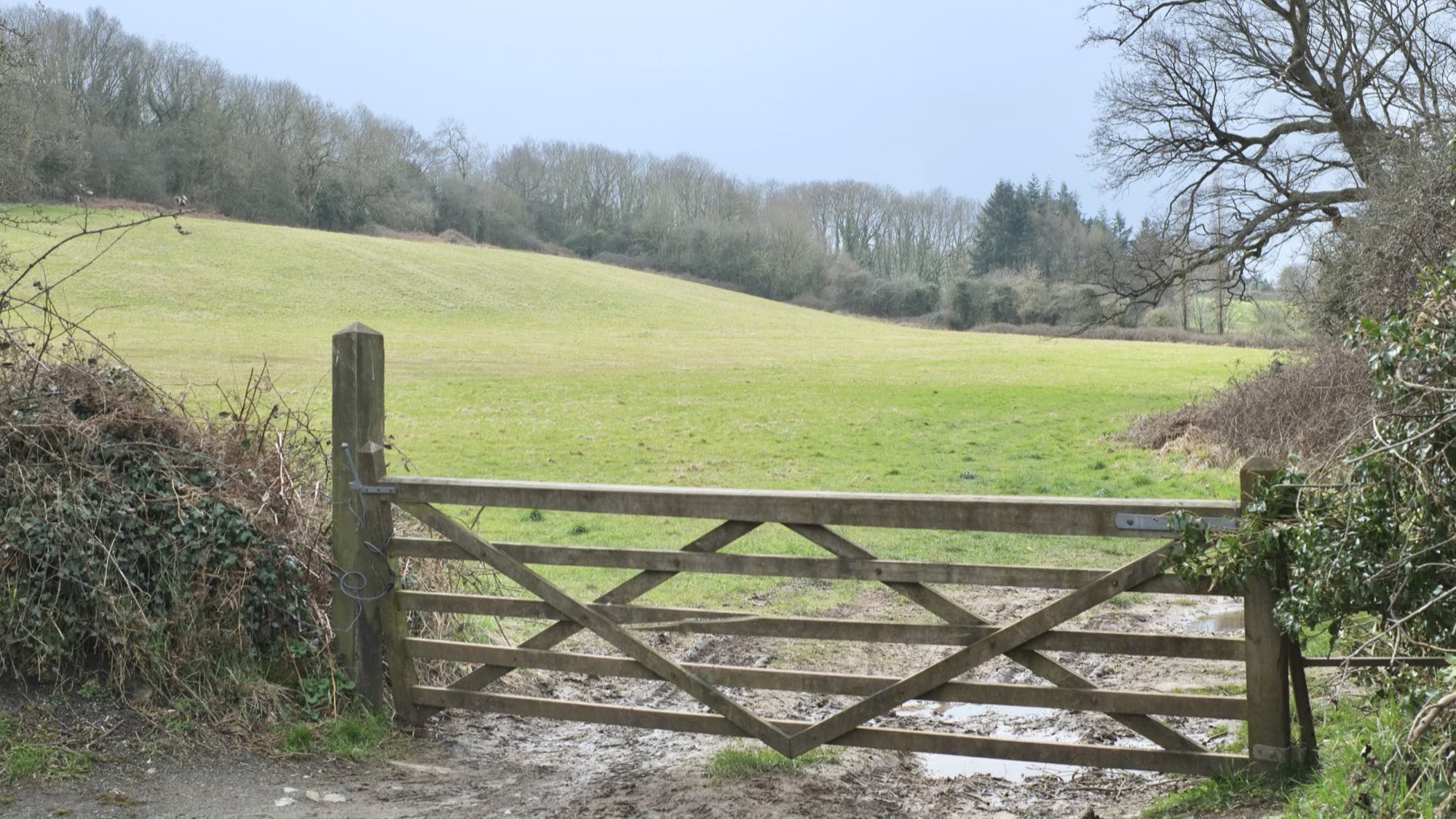
Photograph: Gate to farmland by Anthony O’Neil, cropped, CC BY-SA 2.0 via Geograph.
The problem
Value leaks in the structure, not the headline.
An unsolicited letter arrives. A number is mentioned. It sounds like a lot of money, because measured against agricultural value it is.
What that letter rarely explains is how the number was arrived at, what will be deducted from it before it reaches you, how long your land will be committed, what happens if the planning application stalls, and what the site would fetch if two or three buyers were competing for it instead of one.
None of that is sharp practice. It is simply what happens when one side of a negotiation does this professionally and the other side has never done it before. Closing that gap is the whole job.
“I’d more or less agreed to an option with the first developer who wrote to me. Michael read the draft and pointed out the automatic five-year extension buried in clause 14 — I would never have caught it. We went back, three more developers came to the table, and the terms we signed were unrecognisable from where we started.”
FABRICATED EXAMPLE — NOT A REAL CLIENT · shown to demonstrate the shape a real testimonial should takeBefore you reply to that letter
There is no cost and no commitment in finding out what the land is worth first. It is considerably cheaper than finding out three years into an agreement.
How we help
-
01
Selling land with planning permission
Consented and allocated sites brought to market properly: a marketing pack that answers the questions a land buyer will ask before they ask them, a targeted buyer list rather than a mailshot, informal tender where competition warrants it, and offers compared on deliverability and structure as well as price. Managed through heads of terms, solicitors and conditions to unconditional completion.
-
02
Strategic land — promotion and long-term value
Land without permission assessed against the local plan position, the authority’s housing land supply, the call-for-sites history and the realistic route to allocation. Where promotion is the right answer, selection of a promoter on track record in that authority — not on the percentage quoted in the first meeting — and negotiation of the agreement that follows.
-
03
Reviewing terms you have already been offered
If heads of terms are already on the table, a review before you sign is the highest-value hour you will spend on the whole transaction. What the price mechanism really produces, which costs come off it, how long you are tied in, and what a comparable site would have achieved on the open market.
-
04
Overage, clawback and retained land
Keeping a share of value you are not being paid for today — and protecting land you are keeping. Trigger events, the uplift calculation, duration, security on the title, and the access and services position for anything adjoining that might come forward later.
-
05
Valuation and development appraisal
What a housebuilder can actually pay for your land, built up the way their own land team builds it: revenues, build costs, abnormals, planning obligations, finance, and the profit margin they must show their board. It is a far more useful number than a price per acre.
Common starting points
Where most conversations begin.
“A developer has written to me.”
The most common one, and the moment where advice is worth the most. Before you reply, it is worth knowing whether the approach reflects the site’s value or the sender’s appetite — and whether anyone else should be seeing it.
“My land is in the emerging local plan.”
Allocation changes the value materially, but the timing and the conditions attached to it determine how much of that value you keep. This is the point at which structure matters most.
“I have consent and want to sell.”
The work here is competition and deliverability — getting the right buyers to the table at the same time, and choosing the offer that will actually complete rather than the one with the largest number on it.
“I signed something years ago.”
Options and promotion agreements that have gone quiet, or run past the point anyone expected. There are usually more levers available than landowners assume, and reviewing the document is the first of them.
“I am selling the farm.”
Where part of a holding has development potential, how you separate and structure it affects both the price and the tax position. Best resolved before marketing, not during.
“Is it worth anything at all?”
Sometimes the honest answer is no, or not yet. That is a legitimate outcome of an appraisal, it costs nothing to find out, and it is considerably cheaper than discovering it three years into an agreement.
Fees
Clear, and agreed before we start.
The initial appraisal is free and carries no obligation. Beyond that, work is quoted before it begins under written terms of engagement.
Sale instructions and advisory work — reviewing terms, appraisals, strategy — are agreed in writing before they begin, so you know what you will pay and when.
Start a conversation
Tell us about your land.
A confidential, no-obligation appraisal of what your land could be worth, what consent it might realistically achieve, and which route to market fits your circumstances. No fee, no tie-in.